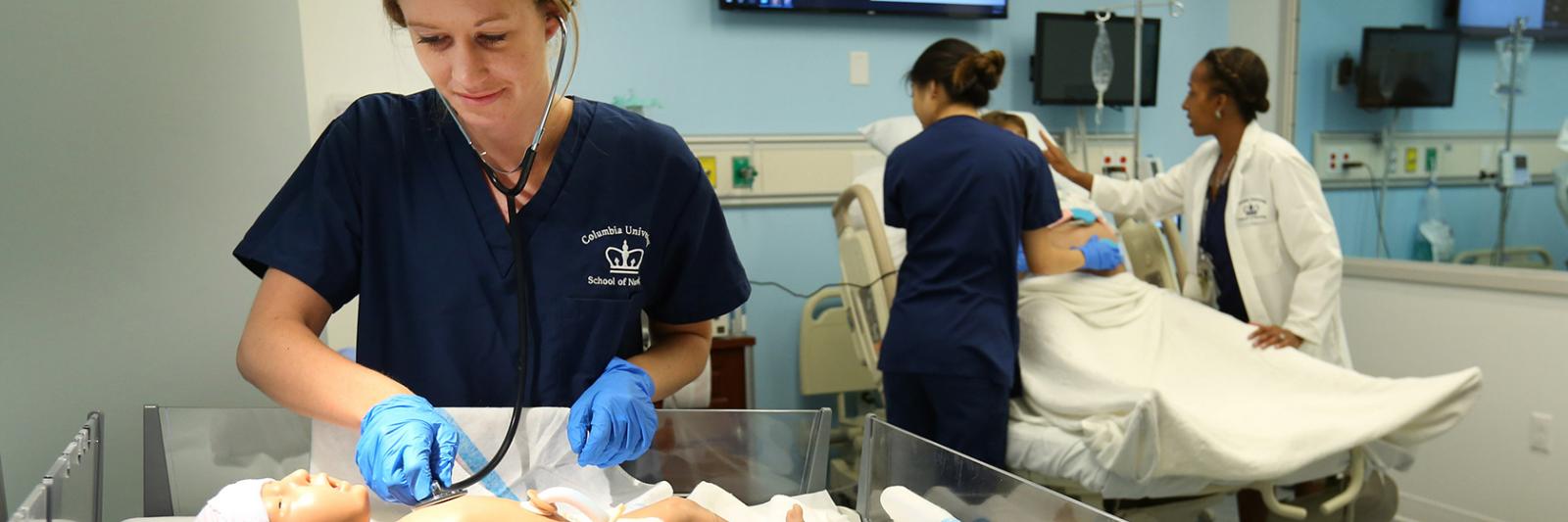
The Family Nurse Practitioner (FNP) Program is designed to prepare nurses to deliver primary health care to families in a variety of settings. Students follow patients through the life cycle utilizing obstetric, pediatric, gynecologic, as well as adult and geriatric primary care diagnostic and management skills.
The scope of practice of the family nurse practitioner is based on a team approach. An interdependent member of the health team, the FNP provides primary care through the following means:
Graduates are eligible to take the certifying examination offered by the American Nurses Association and the American Academy of Nurse Practitioners. Graduates find positions in a variety of settings such as outpatient clinics, community health centers, private practice offices, health departments, homeless shelters, chronic care facilities, schools, day care programs, hospices, homes, and acute care settings.
The Program Director for the Family Nurse Practitioner specialty is Elizabeth Hall, DNP, MSN, CFNP/CGNP.
Clinical sites are available in the tri-state area and beyond, and can be permanent or rotating. Clinical sites vary in setting and you can be assigned location at hospitals, out-patient clinics, home care, or schools to name a few.
Please contact the Office of Admissions for details regarding admission and financial aid packages. Please note, applications for the Family NP Program can only be submitted online.
*RN's with a non-nursing baccalaureate degree are required to complete 5 credits in community health in addition to the course requirement listed. The courses that fulfill the community health requirement are N6703, The Science of Health Promotion and Disease Prevention in the Community (3 didactic credits) and N5292, Nursing Practice in the Community (2 clinical credits).
For Applicants Who Hold an Undergraduate Degree in Nursing
A sample program plan is provided below to make you aware of the academic requirements of the program. Please be advised that this program plan is a sample, and individual plans of study are reviewed and approved upon acceptance to the program. Progression in the program is contingent upon meeting academic policies. The School of Nursing reserves the right to change the course offering schedule as stated in the student bulletin.
| Course Number | Course Name | Credits | Type |
| Summer I: 7 Credits | |||
| N6920 | Health and Social Policy: The Context for Practice and Research | 3 | Core |
| N8102 | Advanced Pharmacology | 3 | Core |
| N8548 | Normal Antepartum for Family Primary Care | 1 | Specialty |
| Fall I: 13 Credits | |||
| N6100 | Advanced Physiology | 3 | Core |
| N6826 | Evaluation and Application of Research | 3 | Core |
| N8557 | Family Primary Care I | 2 | Specialty |
| N8568 | Practicum in Advanced Clinical Assessment for Family Nurse Practitioners | 2 | Specialty |
| N8786 | Advanced Clinical Assessment Across the Lifespan | 3 | Specialty |
| Spring I: 14 Credits | |||
| N6121 | Pathophysiology Across the Lifespan | 3 | Core |
| N8545 | Diagnosis and Management of Illness in Families I | 4 | Specialty |
| N8558 | Family Primary Care II | 2 | Specialty |
| N8560 (Family) | Family Theory in Context | 3 | Specialty |
| N8693 | Family Primary Care: Practicum IIA | 2 | Specialty |
| Summer II: 6 Credits | |||
| N6930 | Interpersonal Violence and Abuse: Prevention, Assessment and Intervention for Health Care Professionals | 1 | Core |
| N6940 | Management and Advanced Practice Nursing | 1 | Core |
| N8566 | Family Primary Care: Practicum IIIA | 2 | Specialty |
| N8795 | Family Primary Care: Practicum IIB | 2 | Specialty |
| Fall II: 10 Credits | |||
| N8290 | Incorporating Genetics into Advanced Nursing Practice | 3 | Core |
| N8546 | Diagnosis and Management of Illness in Families II | 3 | Specialty |
| N8559 | Family Primary Care III | 2 | Specialty |
| N8567 | Family Primary Care: Practicum IIIB | 2 | Specialty |
| Total Credits | 50 | ||
This page was last updated on 03/29/2012 and is subject to change at any time.